
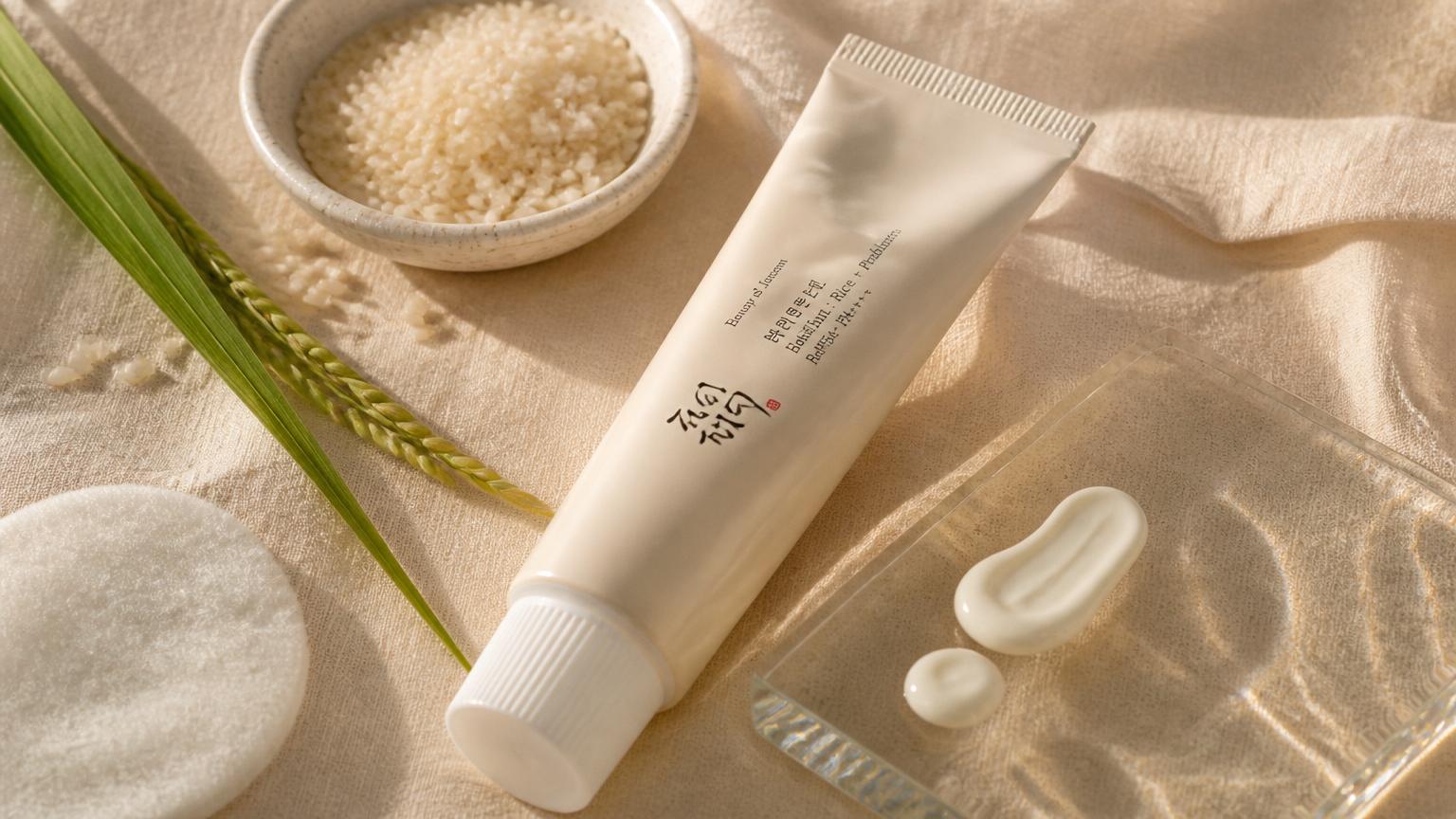
Beauty of Joseon Relief Sun Review: Is It Worth the Hype?
Last updated 10 July 2026
The Beauty of Joseon Relief Sun: Rice + Probiotics SPF50+ PA++++ is one of the most viral K-Beauty sunscreens in the world, backed by four modern UV filters, a 30% rice extract concentration, and a lotion-like finish that most Western SPFs still cannot match. It was even part of the V+A "Korean Wave" exhibition in London in 2022. We break down the ingredients, the science, who this sunscreen is best for, and the one group that should be cautious.
What the Beauty of Joseon Relief Sun actually is
The Beauty of Joseon Relief Sun: Rice + Probiotics SPF50+ PA++++ is the best selling sunscreen of Korean brand Beauty of Joseon and one of the most viral K-Beauty products of the last three years across TikTok, Reddit and Facebook beauty groups.
The hype is not only about the price (roughly 15 to 20 EUR for 50ml). It is the combination of four modern UV filters that most Western formulas do not yet have, a 30% rice extract concentration, and a texture that feels closer to a luxurious day cream than to a traditional sunscreen.
It is freely available in the EU and in Korea. In the US, the original formula was pulled from official sale in February 2025 because the FDA has not yet approved the modern UV filters used in it. American buyers still get it via Asian retailers.
Our verdict
Worth the hype for most skin types. For anyone with normal to dry skin who wants a genuinely comfortable daily SPF that layers well under makeup and does not leave a white cast on light to medium skin tones, this is one of the best value K-Beauty sunscreens on the market.
Best for: normal, dry, combination and dehydrated skin, glow lovers, people who dislike heavy or matte SPF finishes, anyone wanting broad UVA and UVB protection with photostable modern filters. Also very well tolerated after chemical peels and light procedures.
Skip or patch-test carefully if: you have atopic dermatitis with a known rice sensitivity, very oily skin that dislikes dewy finishes, or you need a water-resistant sport SPF. For the rice-sensitive atopic subgroup, we recommend a rice-free alternative like La Roche-Posay Anthelios or ISDIN Eryfotona Actinica instead.
The four UV filters, explained
This is the heart of the product and the reason K-Beauty sunscreens often outperform Western formulas. The four filters used here are not FDA-approved but have been standard in the EU and Korea for years, and are among the best-studied modern UV filters overall.
Diethylamino Hydroxybenzoyl Hexyl Benzoate (Uvinul A Plus): a highly photostable oil-soluble UVA filter with an excellent safety profile. Only small concentrations are needed for high UVA protection.
Ethylhexyl Triazone (Uvinul T 150): one of the most effective UVB filters ever developed. Very photostable, no significant skin penetration. At maximum concentration it generates SPF 12.5 on its own.
Methylene Bis-Benzotriazolyl Tetramethylbutylphenol (Tinosorb M): a broadband UVA and UVB filter that works partly by light scattering, like mineral filters. Extremely photostable. It can cause a mild grey cast on some darker skin tones.
Diethylhexyl Butamido Triazone (Iscotrizinol): loses only 10% of its protection after 25 hours of light exposure, when the standard photostability benchmark is 2 hours. It is the most stable filter in the formula.
Together these four filters cover the full UVA and UVB spectrum and stay photostable throughout the day, without needing a separate stabiliser like avobenzone-based Western formulas do. This is the real technical advantage of modern Korean SPF formulation.
Ingredients and evidence
Oryza Sativa (Rice) Extract at 30% is the main active after water. Rice extract contains gamma-oryzanol (which inhibits melanin production), Ferulic Acid (a UV antioxidant), tocopherols (Vitamin E) and B vitamins. The brightening effect is clinically supported.
Niacinamide sits at position eight on the INCI list, which typically points to a 2 to 5% concentration: brightening, barrier support, sebum regulation and anti-inflammatory activity, all backed by an extensive research base.
A probiotic complex of five fermented extracts (Lactobacillus/Rice Ferment, Lactobacillus/Pumpkin Ferment, Bacillus/Soybean Ferment, Monascus/Rice Ferment and Aspergillus Ferment) adds soothing and barrier-supporting benefits and can improve the penetration of other actives.
Adenosine is recognised by the Korean FDA as an anti-wrinkle active. It supports collagen synthesis and skin firmness. Its inclusion in a sunscreen is a sign of serious formulation work.
Tocopherol (Vitamin E) and Camellia Sinensis (Green Tea) extract deliver antioxidant protection against UV-induced free radicals. Green tea also has documented anti-inflammatory and antimicrobial properties, well tolerated on sensitive and atopic skin at cosmetic concentrations.
SkinSAFE classifies the Relief Sun as 91% free of the 11 most common contact allergens (Mayo Clinic Research). It is fragrance-free, alcohol-free, paraben-free, SLS-free and silicone-free. For most users, a very well tolerated product. The exception is rice sensitivity in atopic dermatitis.
Texture, finish and daily performance
The texture is unusually creamy for a chemical sunscreen with no mineral filters. It absorbs quickly, leaves almost no tackiness, and gives skin a slightly luminous but not oily glow. Many users describe it as day-cream-like, which is both a strength and a limitation.
The finish is satin to lightly dewy, not matte. On olive or darker skin tones, some users can perceive a slight grey cast from Tinosorb M, which scatters light similarly to mineral filters. On lighter skin tones this is barely noticeable.
Works: no white cast on light to medium skin, layers beautifully under makeup, does not sting the eyes, hydrating enough to replace daytime moisturiser on normal to dry skin, no unpleasant SPF smell, four highly photostable UV filters, vegan and cruelty-free, and very good cost per use.
Limitations: not water resistant, so not for sports or beach days; the dewy finish can be too much on very oily skin; the 30% rice extract is a real risk with rice allergy; Tinosorb M can create a slight cast on darker skin tones; the tube gets awkward to squeeze at the end; and it is no longer officially sold in the US.
Which skin type it suits
Dry skin: ideal. The hydrating texture can replace the moisturiser step in summer.
Normal skin: very good. Pleasant glow without greasiness, sits well under makeup.
Combination skin: good. The T-zone can get shiny after a few hours; a light powder is usually enough.
Oily skin: with reservations. Fine in an office setting; the finish gets too dewy in heat or sport. The Beauty of Joseon Relief Sun Aqua-Fresh is the better pick.
Sensitive skin: generally well tolerated, but patch test first, especially given the rice extract content.
Atopic skin with rice allergy: not recommended. 30% rice extract is a high concentration for skin that shows IgE-mediated reactions to rice proteins. See the K-Beauty for sensitive skin guide for safer picks.
Post-laser or post-procedure: well documented tolerability. Soothing ingredients and no irritants; a dermatologist in Singapore has publicly reported very good tolerance after chemical peels.
Very deep skin tones: Tinosorb M can create a slight grey cast on some deep tones. Not always the case, but a known phenomenon worth testing before commiting.
What sensitive and atopic skin needs to know
The founder note above is honest: I tried this sunscreen, developed a rash within days and had to stop. My best friend had exactly the same experience. It does not mean the product is bad. It means we are part of a specific subgroup for which the 30% rice extract concentration is a documented risk.
People with atopic dermatitis often have IgE-mediated sensitivities to plant proteins that do not affect healthy skin. Rice proteins applied topically to a compromised atopic barrier can trigger the same reactions as a food-level rice allergy.
A study from Yokohama City University analysed 1,006 patients with atopic dermatitis. Rice allergy contributed significantly to disease severity in a subgroup. In 25 patients with severe AD and positive rice RAST scores, a rice-elimination diet led to dramatic improvement in 9 patients and moderate improvement in 10. The rice proteins triggering these reactions are the same proteins found in topical rice extracts (PubMed PMID 1476019).
The good news: most people with sensitive skin tolerate the Relief Sun without any issue. It is fragrance-free, alcohol-free and packed with soothing ingredients. The SkinSAFE 91% allergen-free rating reflects that. The rice allergy caveat is specific to the atopic rice-sensitive subgroup, not a general sensitivity issue.
How it compares
vs. La Roche-Posay Anthelios Invisible Fluid: La Roche-Posay is more fluid and dries down more matte. Better for very oily skin or anyone who wants ultra-light. Beauty of Joseon gives more hydration and glow. Both have strong broad-spectrum protection. For sensitive and atopic skin, La Roche-Posay is the safer pick because it contains no rice extract.
vs. ISDIN Eryfotona Actinica: ISDIN is a mineral sunscreen with DNA-repair enzymes and a completely different mechanism. More expensive per tube, but with a unique DNA-protection layer. Often the better choice for sensitive and post-procedure skin. This is what our founder now uses personally after her perioral dermatitis phase.
vs. Beauty of Joseon Relief Sun Aqua-Fresh: the newer sister formula with a lighter texture and hyaluronic acid instead of rice extract as the main active. Better for oily skin and tropical climates, and a much safer option for anyone with rice sensitivity.
Where to buy
In Germany and Austria the Relief Sun is available at Douglas, Notino and YesStyle, and directly on the Beauty of Joseon website. In the US, only via Asian retailers such as YesStyle, Olive Young or Stylevana.
Important: there are several versions on the market. Look for the full product name Relief Sun: Rice + Probiotics SPF50+ PA++++. Many retailers also sell the newer Aqua Fresh or Daily Dew formulas. The original 30% rice extract formula is the one covered in this review, and the one linked in our Amazon Kauf-CTA at the top.
See our full where to buy Korean skincare guide for how to spot counterfeits and which EU and US retailers are trustworthy.
Frequently asked
Keep reading
- Beauty of Joseon Relief Sun product page
- Beauty of Joseon brand page
- Rice Extract ingredient page
- Niacinamide ingredient page
- Beauty of Joseon vs COSRX sunscreen
- Best Korean sunscreens
- Best Korean sunscreen for sensitive skin
- K-Beauty for sensitive skin
- K-Beauty for atopic dermatitis
- Where to buy Korean skincare
- Build your routine
Tool
Build your routine
Pick skin type, concern and budget. Get a step-by-step routine with real products.
Tool
Check ingredient conflicts
Safe to combine, separate AM/PM, or skip. Clear verdicts for any two ingredients.