
Best Korean Sunscreen for Sensitive Skin: What to Look For (and Avoid)
Last updated 21 June 2026
Sensitive skin gets caught in a bad loop: it needs sunscreen more than any other skin type, but most sunscreens make it sting, flush, or break out. Korean sunscreens are uniquely good for sensitive skin because Korean filter regulations allow newer, gentler UV filters that the US still hasn't approved.
What makes a sunscreen sensitive-skin friendly
Modern UV filters: Tinosorb S, Tinosorb M, Uvinul A Plus. Photostable, low irritation, broad-spectrum. Standard in Korea, banned in the US.
Fragrance-free and essential-oil-free. The two biggest hidden irritants.
Alcohol-denat below the top 5 ingredients, or absent entirely.
Soothing actives in the formula: centella, panthenol, allantoin, beta-glucan.
Mineral-only options for the most reactive skin: zinc oxide as the primary filter.
Korean sunscreen types and which suits which skin
Chemical fluids (lightest finish): great for normal-sensitive and combination-sensitive. Look for centella or madecassoside in the formula.
Hybrid sunscreens (mix of chemical + mineral): the best all-rounder for reactive skin.
Pure mineral (zinc-only): the safest pick for rosacea-prone, post-procedure, or pregnancy.
Tone-up sunscreens: avoid if you flush easily, the brightening pigments can highlight redness.
Ingredient flags to avoid
Avobenzone alone: photo-unstable, often paired with octocrylene which is a known irritant.
Methylisothiazolinone (MI/MCI): a preservative banned in EU leave-on cosmetics but still appears in some imports.
Lavender, citrus, peppermint essential oils. Common in K-Beauty sun sticks.
High SD alcohol content (over 5%): triggers stinging on reactive skin.
How to test a new sunscreen safely
Patch test on the inner arm for 2 days.
Then patch on the jawline for 2 more days.
Then apply to half the face for 3 days before going full face.
If it stings within minutes, that is irritation. If you break out after a week, that is comedogenicity. Different problems, different fixes.
Beyond Filters: Calming Ingredients in Korean Sunscreens
Modern Korean sunscreens often double as soothing treatments, thanks to their inclusion of powerful calming ingredients. Look for Centella Asiatica, also known as Cica, and its derivatives like Madecassoside and Asiaticoside. These compounds are famed for their ability to repair the skin barrier, reduce redness, and calm inflammation, making your sunscreen work to improve your skin's resilience while it protects.
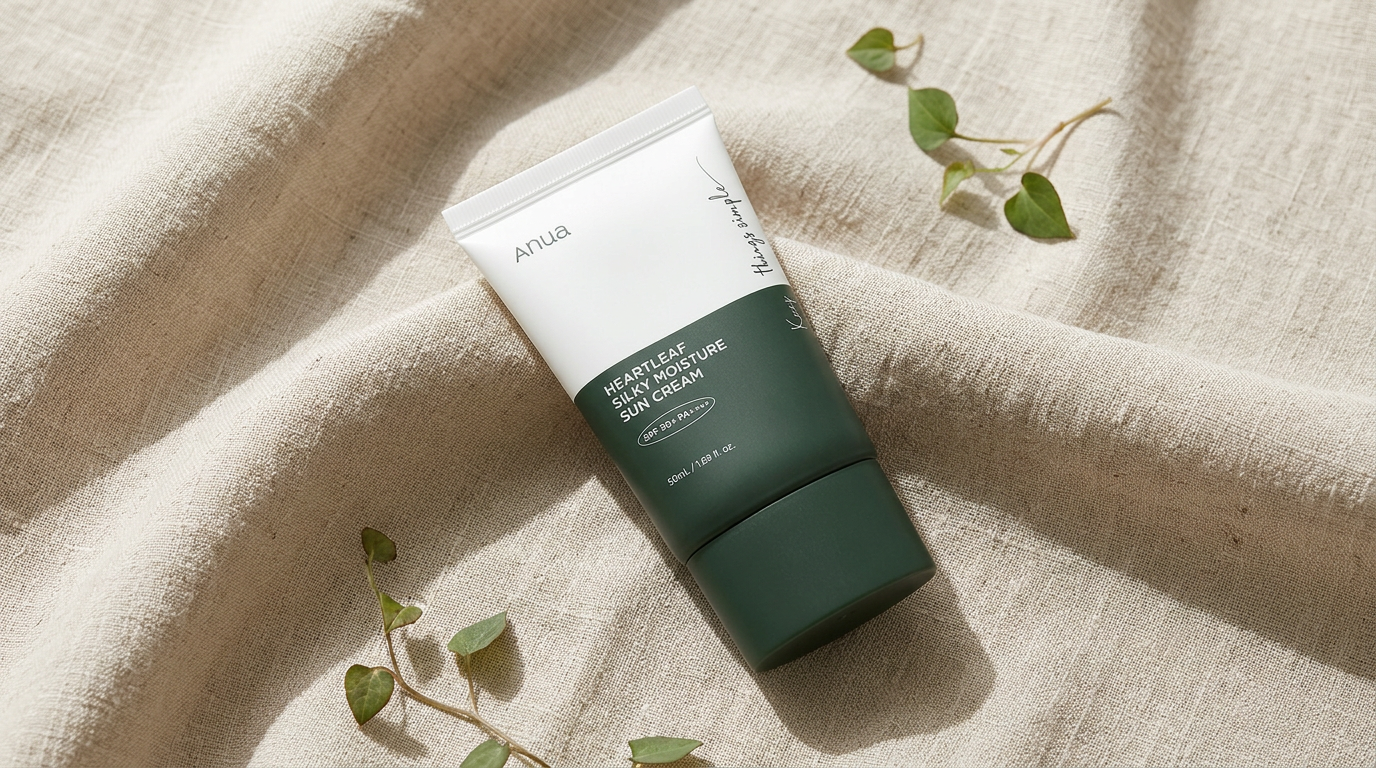
Heartleaf (Houttuynia Cordata) is another hero ingredient you will frequently find. It is particularly beneficial for skin that is both sensitive and prone to breakouts. Its anti-inflammatory and antibacterial properties help to soothe irritation and keep pores clear. Many popular sunscreens, like the Anua Heartleaf Silky Moisture Sun Cream, are built around this gentle botanical.
Do not overlook ingredients like Panthenol (Pro-vitamin B5) and Allantoin. Panthenol acts as a humectant, drawing moisture into the skin, and helps accelerate skin cell turnover, which is crucial for healing. Allantoin is a brilliant skin protectant that softens the skin and buffers it against potential irritants in the environment. These ingredients turn a daily necessity into a genuine skincare step.
Finally, Korean formulators often include fermented ingredients and ceramides. Ferments can help support a healthy skin microbiome, while ceramides are lipids that are essential for a strong, intact skin barrier. A healthy barrier is less susceptible to irritation from UV rays and other external stressors, making these additions incredibly valuable for long term skin health.
How to Reapply Sunscreen Without Irritation
Reapplication is non-negotiable for effective sun protection, but rubbing a cream onto sensitive skin every two hours can be a recipe for redness. The key is to choose the right format and use a gentle technique. Sun sticks are an excellent option as they glide over the skin with minimal friction. Look for silky, non-waxy formulas like the Isntree Hyaluronic Acid Airy Sun Stick to avoid pulling or dragging.
When applying a sun stick, use light pressure and make sure to pass over each area of the face two to four times to ensure you achieve adequate coverage. For reapplying over makeup, a sun cushion is often a better choice. These sponges are saturated with a liquid sunscreen formula that can be gently pressed onto the skin, depositing a fresh layer of protection without smudging your makeup underneath.
If you must reapply a traditional lotion or cream sunscreen, technique matters. Instead of rubbing it in, warm the product between your fingertips and gently pat it onto your face. This pressing motion minimizes friction and reduces the chance of disturbing your skin or the makeup underneath. It may take a little longer, but your calm skin will thank you for it.
A final caveat: reapplication over makeup, sweat, and oil is a compromise. It is better than no reapplication at all, but it will never be as effective as a fresh application on clean skin. When possible on long beach or park days, consider a quick cleanse with micellar water on a cotton pad before reapplying your sunscreen for the most reliable protection.
Decoding Sunscreen Textures for Sensitive Skin
The texture of a sunscreen dramatically impacts how it feels and whether you will enjoy using it daily. Korean brands excel at creating diverse textures for every skin type and preference. Understanding these can help you find your perfect match, preventing the dreaded feeling of a heavy or greasy film on your skin.
Sun essences and serums have a watery, lightweight consistency that sinks in almost instantly. They are ideal for oily, combination, and acne-prone skin types that are also sensitive, as they provide high protection without feeling heavy or clogging pores. Products like SKIN1004's Hyalu-Cica Water-fit Sun Serum are popular examples that leave a natural, non-greasy finish.
Sun creams and lotions offer more hydration and are better suited for normal to dry sensitive skin. They often contain moisturizing ingredients that help support the skin barrier throughout the day. Don't assume 'cream' means heavy. Many modern Korean sun creams, such as the Round Lab Birch Juice Moisturizing Sun Cream, feel more like a comfortable daily moisturizer than a thick, old-fashioned sunblock.
Sun sticks provide a unique, semi-solid format for targeted and on-the-go application. They are brilliant for the eye area, around the nose, and for reapplication. Their balmy texture can range from silky and matte to slightly dewy, so it is worth checking reviews to find one that suits your preference. They are particularly good for anyone who dislikes the feeling of sunscreen on their hands.
| Texture | Best For Skin Type | Finish | Example Use Case |
|---|---|---|---|
| Essence / Serum | Oily, Combination, Acne-Prone | Natural, often dewy | Daily wear under makeup |
| Gel / Gel-Cream | Normal, Combination | Fresh, lightweight | Hot and humid weather |
| Cream / Lotion | Normal, Dry, Dehydrated | Moisturizing, radiant | Dry climates or winter months |
| Stick | All skin types | Varies from matte to dewy | Reapplication, eye area, travel |
Troubleshooting: When a 'Safe' Sunscreen Still Stings
It is disheartening when you choose a sunscreen designed for sensitive skin and it still causes stinging or redness. Before you blame the sunscreen, consider your skin barrier's current condition. A compromised barrier, caused by over-exfoliation, harsh cleansers, or environmental stress, is more permeable and will react to ingredients that it would normally tolerate just fine.
If your skin stings upon application, try simplifying the rest of your routine. Pause use of all active ingredients like retinoids, vitamin C, and exfoliating acids for a week. Focus on hydration and repair with gentle cleansers and barrier-supporting moisturizers containing ceramides, panthenol, or cica. Once your skin feels calm, reintroduce the sunscreen and see if the reaction persists.
Also, consider product interactions. Sometimes, a reaction is not caused by the sunscreen itself, but by how it interacts with a product applied underneath. Pilling or balling up can be a sign of ingredient incompatibility, for example between a silicone-based primer and a water-based sunscreen. This pilling can increase friction and irritation during application.
If you have tried everything and a range of gentle sunscreens still cause problems, it might be time to see a dermatologist. You may have a specific allergy to a common sunscreen filter, preservative, or fragrance component that requires patch testing to identify. A professional can help you pinpoint the exact culprit and find a truly safe alternative.
Reader favorites
The products from this guide our readers click most.
Swipe for more →

Frequently asked
Products in this guide
Prices, ratings and short verdicts from our database, linked to the full product page.
Keep reading
Tool
Build your routine
Pick skin type, concern and budget. Get a step-by-step routine with real products.
Tool
Check ingredient conflicts
Safe to combine, separate AM/PM, or skip. Clear verdicts for any two ingredients.