Is Korean Skincare Actually Better? An Honest Comparison
Last updated 21 June 2026
Korean skincare has spent ten years being marketed as a quiet revolution. Better ingredients, better textures, half the price. The reality is more interesting than the marketing, and more useful if you actually want to spend your money well. Here is the honest comparison: where Korean skincare genuinely beats Western brands, where it does not, and how to build a routine that takes the best of both.
The short verdict
Korean skincare is better than Western mass-market skincare in four specific areas: sunscreen, hydration essences and toners, gentle daily treatment serums, and value at the mid-range price point.
Western skincare still wins for prescription-strength actives (tretinoin, prescription azelaic acid), heavy-hitter cosmeceutical brands (SkinCeuticals, La Roche-Posay, Paula's Choice for BHA), and clinically-tested anti-ageing systems backed by published trials.
The smartest routines in 2026 are hybrid. Pick the best product per category, regardless of which country it ships from.
Where Korean skincare clearly wins
1. Sunscreen. This is not close. Korean sunscreens benefit from filters approved in Asia and Europe but not the US (Tinosorb S, Tinosorb M, Uvinul A Plus), and have spent a decade refining cosmetic elegance. Beauty of Joseon Relief Sun, Round Lab Birch Juice, and Anessa from Japan all outperform the average Western chemical sunscreen on texture, finish, and broad-spectrum protection. If you live in the US, this is the single biggest reason to buy Korean.
2. Hydration layering. Korean toners and essences (Anua Heartleaf, Pyunkang Yul, Klairs, Torriden, Beauty of Joseon Hanbang) are formulated as watery, layerable humectants in a way Western routines simply do not offer at the same price.
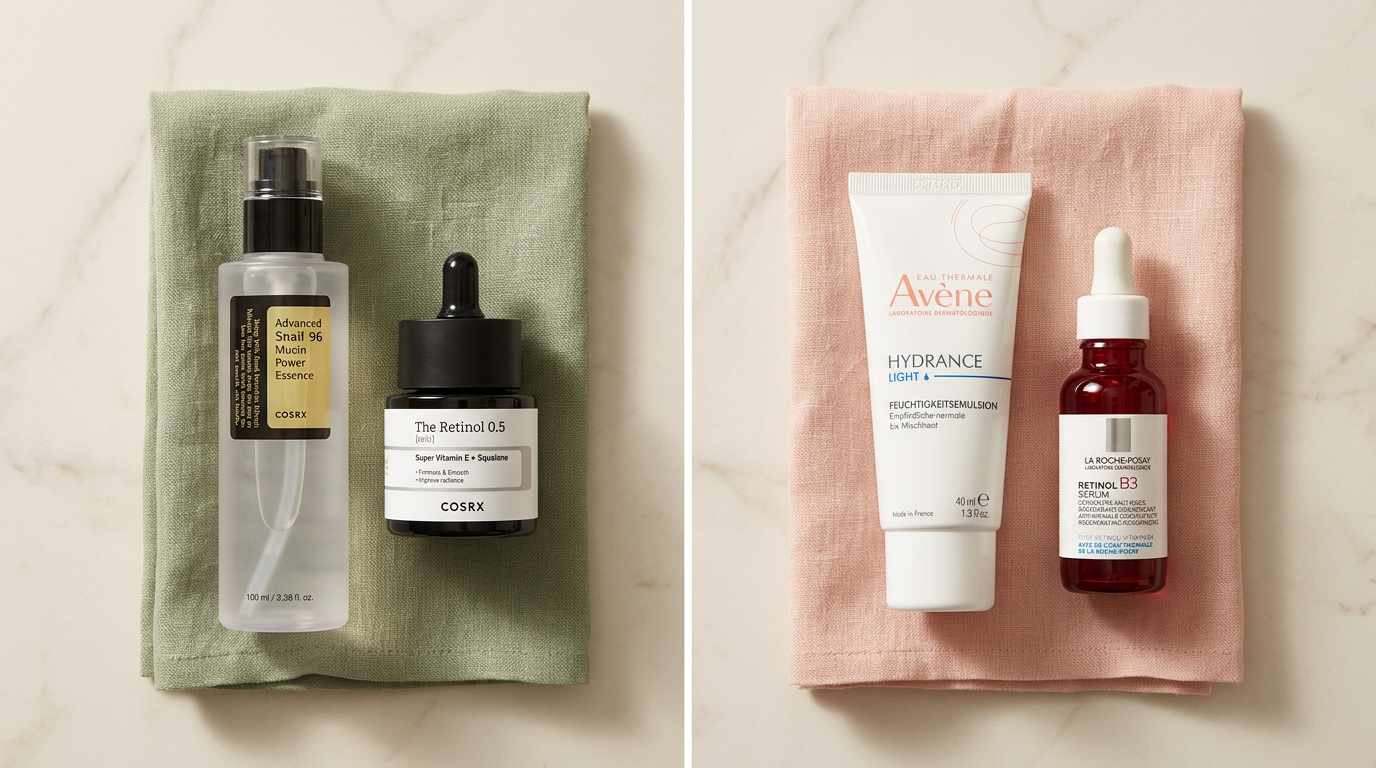
3. Gentle daily actives. Snail mucin, propolis, centella asiatica, mugwort, and rice extract serums sit in a sweet spot of effective and well-tolerated that Western brands rarely match. They make consistent daily use sustainable.
4. Mid-range value. A 20 EUR Korean serum is typically formulated with more interesting ingredients than the same-price Western equivalent. The gap narrows at the premium tier and disappears at the prescription tier.
Where Western skincare still wins
1. Prescription retinoids and azelaic acid. Korea has stricter regulations on retinoids in over-the-counter products, so the strongest retinoid you can buy in a Korean shop is generally weaker than a US prescription tretinoin or even an OTC Differin. If you need clinical-strength acne or anti-ageing treatment, Western dermatology still leads.
2. Pigmentation actives at high concentrations. Hydroquinone, prescription kojic acid blends, and clinical-grade vitamin C systems (SkinCeuticals C E Ferulic) are stronger and better tested than the equivalent Korean OTC formulas.
3. Targeted barrier creams and post-procedure care. La Roche-Posay Cicaplast and Avene Cicalfate are still the benchmarks for compromised skin recovery, and Western dermatology has decades of clinical data behind them.
4. Allergen labelling and fragrance transparency. EU brands in particular are required to disclose 26+ fragrance allergens by name. This can be more reassuring than the broad 'fragrance' label that still appears on some Korean products.
Pricing, honestly compared
A direct mid-range comparison. Same step, same skin goal, real 2026 prices.
| Step | Korean pick | Western pick | Price gap |
|---|---|---|---|
| Daily sunscreen SPF50+ | Beauty of Joseon Relief Sun (16 EUR) | La Roche-Posay Anthelios UVMune (22 EUR) | Korean 30% cheaper, arguably better texture |
| Hydrating serum | COSRX Snail 96 Essence (22 EUR) | The Ordinary Hyaluronic Acid 2% (8 EUR) | Western cheaper, Korean more sophisticated |
| Niacinamide serum | Numbuzin No.3 Skin Softening Serum (24 EUR) | The Ordinary Niacinamide 10% + Zinc (7 EUR) | Western cheaper, Korean gentler and pairs better with retinol |
| Beginner retinol | Innisfree Retinol Cica Repair Cream (28 EUR) | Paula's Choice 1% Retinol Treatment (60 EUR) | Korean cheaper, Western stronger |
| Barrier moisturiser | Illiyoon Ceramide Ato Cream (20 EUR) | La Roche-Posay Cicaplast Baume B5 (16 EUR) | Roughly equal on price, both excellent |
Mid-range Korean vs Western, head to head.
Regulation and ingredient innovation
Korea's Ministry of Food and Drug Safety (MFDS) has a faster approval pathway for new cosmetic ingredients than the US FDA, which is why so many novel UV filters, peptides, and fermented extracts appear in Korean products years before they reach the US market.
The EU is roughly on par with Korea for ingredient innovation but stricter on labelling. The US sits behind both, with a smaller approved sunscreen filter list and fewer recent additions to the OTC ingredient inventory. This is the structural reason Korean and European sunscreens consistently outperform US ones.
How to build a smart hybrid routine in 2026
The honest best-of-both routine looks like this:
1. Cleanser: Korean (Anua Heartleaf, Beauty of Joseon Green Plum) or French pharmacy (La Roche-Posay, Avene).
2. Toner or essence: Korean. This is their home turf.
3. Treatment serum: Korean for gentle daily use (snail mucin, propolis, niacinamide), Western for high-strength actives (prescription retinoid, SkinCeuticals C E Ferulic).
4. Moisturiser: either, depending on your skin type. Illiyoon and Beauty of Joseon for hydration, La Roche-Posay and Avene for compromised barriers.
5. Sunscreen: Korean (Beauty of Joseon Relief Sun, Round Lab Birch Juice) or European (La Roche-Posay UVMune 400, Avene Solaire UV). Avoid the older US-only filters if you have a choice.
Picking by category instead of by country is what consistently produces the best routine.
Frequently asked
Products in this guide
Prices, ratings and short verdicts from our database, linked to the full product page.
Keep reading
Tool
Build your routine
Pick skin type, concern and budget. Get a step-by-step routine with real products.
Tool
Check ingredient conflicts
Safe to combine, separate AM/PM, or skip. Clear verdicts for any two ingredients.